Category: Analog Film

Emancipation and Alchemy

I shot this Toronto street image below on Kodak Tri-X film, one of the all time classic black and white films. I shot a lot of this in the 1970’s, and a few weeks ago I decided to step back in time and shoot it again. Then it sat on the shelf until I finally got a developer tank and some chemicals. I finally got around to doing so, and yesterday developed my first roll of film in about thirty years.

Smiling Pedestrian

The ritual came back fairly easily; loading the developer tank in complete darkness, then putting the lid on, turning on the light and “souping” the film in the various chemicals. My “darkroom” (actually our basement bathroom) soon took on the smell of acetic acid (vinegar), but at the end of it all the negatives came out fine; I let the film dry, and a few hours later I had scans of the negatives, including this image. It wasn’t as fast as snapping a photo and looking at the LCD panel on the back of my DSLR, but it will do just fine.

It’s neat to be doing my own processing again, and the alchemy has its own magic. πŸ™‚

TimeWarp Tuesday: Manipulation Before PhotoShop

One of the photo sites I hang out on is The Analog Photography Users Group (apug.org). This is a group of people who are dedicated to keeping film photography alive in the face of the digital onslaught. It does have its fair share of purists, who refuse to have anything to do with anything digital, including the hybrid workflow (scanning slides/negatives/prints into a computer and then working on the images in PhotoShop or some other image editing application). One can submit hybrid workflow images to the photo gallery on apug.org but they must be “straight prints.” No other digital manipulation is allowed.

The issue that I have is that almost every kind of manipulation one can do in PhotoShop can be done in a traditional darkroom. I created the image below in the late 1970’s, and what is featured here is a straight scan of the 1970’s print. The effects were done with a combination of solarization and bas-relief, on the print itself, in a traditional dark room. If I did the effects digitally, why would that make it any less valid?

David with Lightbulb

Obsolescence Rocks, Again!

Once again, I celebrate photographic “obsolescence.” I have been wanting to try medium format photography for some time, and last week a listing appeared on eBay for a Mamiya 645J with three lenses. This camera takes 120 roll film, and creates negatives 6cm x 4.5 cm in size. The seller was local to Toronto, so I could avoid shipping/customs fees, although I did have to pay tax. Still, for about $400 I got everything I need to try my hand at medium format film. To put that cost in perspective, the list price for a modern digital equivalent to this camera is well over $5,000 no lens included. I’ll be able to shoot a lot of film with this price differential πŸ™‚ .

The image below was from my first test roll, shot beside the Don River in Toronto yesterday morning.

Water on the Rocks

Time-Warp Tuesday: Jock Shot

This week I go further back, to first year university in 1980; I was in residence at the University of Waterloo, and with a lot of jocks around, there was no shortage of photo opportunities, such as the night shot below of one of the skiers who will built a jump beside the residence. This image was shot on Ektachrome, with a small flash unit.

Scan-101025-0002

I have never been good at sports, and I’m OK with that: the things I love to do (i.e. Photography, music etc) are things I’ll be able to do into my 80’s (assuming I make it out that far, and I certainly hope to be!). I’m not sure ski-jumping would be the best thing to do in one’s 80’s!

Jumping (Or Becoming) the Shark

Today’s picture is not great art;Β  it is just a snapshot. However, it is the best image for the point I want to make today.

The image is of three attendees from the recent Kodachrome photo-walk I’ve mentioned a few times, and the key point is that all three people in the image have cameras, and were actively shooting, creating images at the event. At every other photo walk I’ve been to, it’s been the same; the emphasis has been on creating images, and sharing the joy of doing so in a social setting.

Friends at the Kodachrome Film Walk

When I compare the photo-shoot vibe and attitude to what I’ve experienced at recent podcamps, the podcamps do not come out on top. Podcamps used to be about creativity (heck, they used to be about podcasting!), but to me it doesn’t seem to be that way any more. The best way for me to describe how I see podcamps now is to describe how a photo-walk would be if it followed the spirit of current podcamps:

  1. Only a distinct minority would actually carry cameras.
  2. There would be very little discussion of actual photographic techniques.
  3. Amateurs would definitely be in the minority.
  4. We would have sessions and/or discussions like “How to pick the best camera gear to impress an creative director”, “Making money from iStock and Getty” and “Tagging strategies for Flickr”.
  5. For the most part, the only pictures we would see would be images of people’s photographic equipment.

I could go on, but I think the point is clear; Photo-walks are about creating, and podcamps, despite the best efforts of a determined minority, are about marketing.

Podcamp, you’ve jumped the shark. So long, we barely knew ya.

Kodak Ektar 100: Falling in Love

It is sadly ironic that at what might appear to be the twilight of the analog film era some of the best films ever made are now available. I’ve only shot a couple of rolls of it so far, but Kodak Ektar 100 colour negative film is rapidly becoming my favourite colour film. I used to see colour negative film as a decidedly poor sister to slide fim, in terms of sharpness and saturation, but I see no such weakness in Ektar 100. The image below is from the Kodachrome walk, where in addition to some Kodachrome I did shot a roll of Ektar. I look at the blues and red/oranges, and I’m in love with this film!

06410009

Portrait of an Artist: David William White

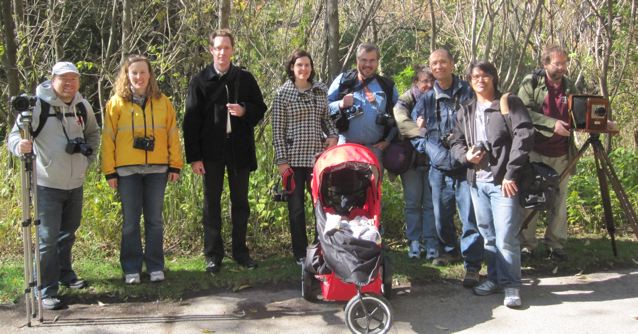
David William White is a photographer I met this past Saturday at the Kodachrome photo-walk at Morningside Park in Scarborough. He is shown below with the camera he brought along: a view camera over 100 years old. On a day when the retro feel of film cameras was in the air, he really underscored the feeling by shooting with this camera. He was also using the paper negative technique, a process that goes back to the dawn of the photographic era. (After all, Fox Talbot used paper negatives in the calotype process of the 1830’s/40’s.)

View Camera Fan

It was great to know that on the same day as a glitzy photo show,Β  showcasing all the new high-priced digital toys available was going on in Mississauga, at the other end of Toronto David was quietly going about his craft, exploring and typifying what is special about traditional photography.

A Great Day for the Kodachrome Photo-Walk

Thanks to “The Scarborough Dude” for the photo!

It was a great day for the Kodachrome photo-walk in Morningside Park in Scarborough, Ontario yesterday; we couldn’t have ordered better weather, and we had a really nice group of people in attendance. The most popular cameras were Nikons, from a Nikkormat FT2 (mine) to a beautiful F100. A couple of folks had Pentax cameras, and one lucky attendee (here from Texas!) had a gorgeous Leica M6 rangefinder.

What was also really neat to see was over one century-old view camera brought along by one attendee; he wasn’t able to shoot Kodachrome, but instead was shooting paper negatives. Imagine, in an era where digital cameras are declared obsolete after a few years, here was a camera from around 1901, still being used to make images!

The leaves were beautiful, and I can’t wait to see the images. Waiting is part of the experience of course; it will be about a month before we get our slides back. By then the leaves we made images of today will long since be gone, but thanks to Kodachrome the colours will last a long long time!

Portrait of an Artist: Sage Tyrtle

One of my photography projects this fall is to take environmental portraits of various creative people I am lucky to know. For this project I am using black and white analog film, and old cameras in order to get a more organic look for the images. The artist featured in this image is podcaster Sage Tyrtle.

Sage Tyrtle

Simply put, Sage is perhaps the most talented podcaster I know. Her podcast QN is always thought-provoking, often very funny in an ironic and sardonic kind of way, and always extremely well crafted both from a technical point of view and especially in terms of the writing involved.

Shooting this image was challenging; I used my old Nikkormat FT2 with a 24mm f2.8 Nikkor lens (one of my favourites), and Ilford XP2+ film. Technically it was a very challenging shoot, with dim lighting and very little room to work in. Also, the shutter on this 35 year old camera started sticking, ruining a number of frames. I literally got only one usable frame (the one you see above) but I was really happy with how the image turned out; I think it captured Sage’s energy and joy in doing what she loves to do.

Icon or Eyesore?

From the beginning, the crystal addition to the Royal Ontario Museum in Toronto has been a source of controversy. Β Some people like it, and many people (probably the majority) consider it an eyesore. For the record, I actually like it, and the way it is juxtaposed against a more traditional building. From a photography point of view, it is a most interesting subject!

No Right Angles

Nikkormat FT2, Tokina 35-105mm lens, Ilford XP2+ film