Category: Black & White

TimeWarp Tuesday: Manipulation Before PhotoShop

One of the photo sites I hang out on is The Analog Photography Users Group (apug.org). This is a group of people who are dedicated to keeping film photography alive in the face of the digital onslaught. It does have its fair share of purists, who refuse to have anything to do with anything digital, including the hybrid workflow (scanning slides/negatives/prints into a computer and then working on the images in PhotoShop or some other image editing application). One can submit hybrid workflow images to the photo gallery on apug.org but they must be “straight prints.” No other digital manipulation is allowed.

The issue that I have is that almost every kind of manipulation one can do in PhotoShop can be done in a traditional darkroom. I created the image below in the late 1970’s, and what is featured here is a straight scan of the 1970’s print. The effects were done with a combination of solarization and bas-relief, on the print itself, in a traditional dark room. If I did the effects digitally, why would that make it any less valid?

David with Lightbulb

Obsolescence Rocks, Again!

Once again, I celebrate photographic “obsolescence.” I have been wanting to try medium format photography for some time, and last week a listing appeared on eBay for a Mamiya 645J with three lenses. This camera takes 120 roll film, and creates negatives 6cm x 4.5 cm in size. The seller was local to Toronto, so I could avoid shipping/customs fees, although I did have to pay tax. Still, for about $400 I got everything I need to try my hand at medium format film. To put that cost in perspective, the list price for a modern digital equivalent to this camera is well over $5,000 no lens included. I’ll be able to shoot a lot of film with this price differential 🙂 .

The image below was from my first test roll, shot beside the Don River in Toronto yesterday morning.

Water on the Rocks

Portrait of an Artist: David William White

David William White is a photographer I met this past Saturday at the Kodachrome photo-walk at Morningside Park in Scarborough. He is shown below with the camera he brought along: a view camera over 100 years old. On a day when the retro feel of film cameras was in the air, he really underscored the feeling by shooting with this camera. He was also using the paper negative technique, a process that goes back to the dawn of the photographic era. (After all, Fox Talbot used paper negatives in the calotype process of the 1830’s/40’s.)

View Camera Fan

It was great to know that on the same day as a glitzy photo show,  showcasing all the new high-priced digital toys available was going on in Mississauga, at the other end of Toronto David was quietly going about his craft, exploring and typifying what is special about traditional photography.

Time-Warp Tuesday: North Rustico, Prince Edward Island, 2004

Again not too far back into the past this week. This is an image I made in North Rustico, Prince Edward Island back in 2004. The image appeared (to my eyes) rather non-descript in colour, but when I converted it to black and white, I liked it a a lot better. I used my old Canon Digital Rebel, with the 18-55mm kit lens at 18 mm (equivalent to about 24mm for a 35mm camera) to include as much foreground as possible.

North Rustico

Portrait of an Artist: Sage Tyrtle

One of my photography projects this fall is to take environmental portraits of various creative people I am lucky to know. For this project I am using black and white analog film, and old cameras in order to get a more organic look for the images. The artist featured in this image is podcaster Sage Tyrtle.

Sage Tyrtle

Simply put, Sage is perhaps the most talented podcaster I know. Her podcast QN is always thought-provoking, often very funny in an ironic and sardonic kind of way, and always extremely well crafted both from a technical point of view and especially in terms of the writing involved.

Shooting this image was challenging; I used my old Nikkormat FT2 with a 24mm f2.8 Nikkor lens (one of my favourites), and Ilford XP2+ film. Technically it was a very challenging shoot, with dim lighting and very little room to work in. Also, the shutter on this 35 year old camera started sticking, ruining a number of frames. I literally got only one usable frame (the one you see above) but I was really happy with how the image turned out; I think it captured Sage’s energy and joy in doing what she loves to do.

Telling a Story

I like street photography that hints at the stories that are hidden inside of everyone. I took this photography in Brussels this past August, in an historic part of town called Central Place. It is an amazing old square with a lot of great historic architecture, but the people who filled it gave it its vibe, and its stories. We only had one night there, but I am longing to go back.

DSC_0197

The Ghost Bike

People used to say “the camera never lies.” Nonsense. The world is 3-D, cameras for the most part are 2-D. The world (for humans at least) is in colour, and photographs are often in black and white. I would go so far as to say that what makes a photograph special is how it differs from reality, and that the difference directly informs what the photographer is trying to say in an image.

The image below is unrealistic. It is black and white, and deliberately underexposed to bring out the white bicycle and roses, which where in fact a temporary monument to cyclists killed on Toronto streets earlier this year.  (The monument has since been removed.)  For the subject matter, the non-realism I added to the image for me captures a tragic reality, and that’s as real as it gets.


Bicycle Memorial, Toronto

Time-Warp Tuesday: The Eternal Summer

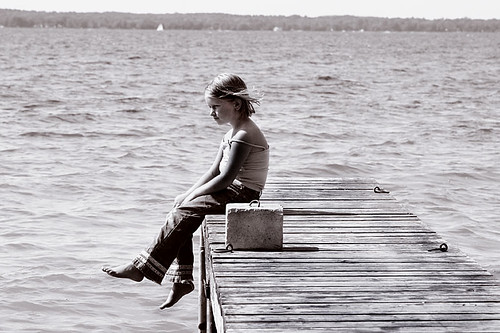
This week’s time warp doesn’t go back as my other time warps to date.  The image below is not even analog film, but a digital image created in late summer, 2004 using my old Canon Digital Rebel. The picture is a portrait of my niece, sitting on the deck of my sister’s cottage.

katie-at-the-dock

In Canada, summer is a temporary, uncertain season; we know that the inevitable shadow of winter is lurking beneath the horizon. But for a moment, whether the moment that is summer or the seeming moment that is childhood, time can stand still, allowing us to contemplate the peace, contentment and joy of that fleeting time.

In the six years that have passed, we have known plenty of winter in the relentless passing of time; childhood has been left behind, loved ones have passed away, and summer has often seemed distant. At least a photograph allows us to perceive a visual echo of a perfect, eternal moment.